
Why Are There No Evangelical Elites?
Aaron Renn wrote an interesting piece today observing that Evangelicalism does not seem to produce elites. In this piece I share some thoughts on why I think this is the case.

I think Aaron M. Renn hits the mark with his most recent piece.

He is correct in noting that there are precious few, if any, Evangelical elites. This is a problem. Why is it this way? I thought it might be useful for discussion purposes to take a stab at trying to answer this question because it is important for the future of both Protestant Christianity in North America and the larger North American social and political landscape. So, let’s have a go at answering the question, “Why are there no Evangelical elites?” I am not an Evangelical myself. I belong to a confessional Reformed tradition rooted in the Netherlands. Back in the “old country” my tradition produced the Free University and Abraham Kuyper who became prime minister at the peak of neo-Calvinist influence. But I have enough contact and interaction with Evangelicals to have formed opinions in this regard. So, why is it that Evangelicals don’t produce elites, or, shall we say, a rival elite class?
First of all, we should define our terms. From the introduction to Vilfredo Pareto’s The Rise and Fall of Elites, this handy definition of an “elite” is useful:
“Those who score highest on scales measuring any social value or commodity (utility).”
This can apply across a variety of aspects and segments of society. In terms of power and politics, they would be the most powerful. In terms of business or material success, they would be the richest. In academic circles, they would be the most erudite and knowledgeable. In religion, they would be the most holy. In the arts, they are the most artistic. You get the idea. Other than perhaps in the area of growing large mega-churches, evangelicals don’t really contribute elites to any part of North American society. Within the Evangelical community and Protestantism more generally, pastors of large churches seem to have the most elite cache. In this, Renn is correct. They are the ones to whom the people look to for leadership and all the cues as to what they should be and to what they should aspire. Beyond this one area, they really are without influence. Why is this? There are a number of reasons.
Evangelicalism Is “Low Brow”
Evangelicalism is the “low-brow” church for the bumpkin masses. To be Evangelical is to be downscale and by definition “not elite.” If you identify as an Evangelical, you are telling someone that you are not a person that needs to be taken seriously by the broader society. Nobody needs to look up to you or take their cues from you. For that reason, if you are at all a striver, if you desire to be a mover and shaker and get invited to all the right parties, you will hide or downplay your Evangelical roots for all the same reasons that you might try to get rid of a southern accent. If you want to become elite, you must put your Evangelicalism behind you. There are many, many stories of successful people making public rejections and renunciations of the Evangelical faith of their youth. Evangelicalism is for the people who live in the trailer parks. It’s not for anyone who wants a successful life in the public square.
Anti-Intellectualism
Evangelical attitudes towards elite scholarship and learning can be summed up in the phrase, “no creed but Christ.” Anti-creedalism means that there is no dominant internal theology that binds and generates intellectual activity within the Evangelical community. You can’t have a neo-Calvinist prime minister without Calvinism, without a defined body of knowledge out of which one can develop and do serious scholarship. While there are Evangelical seminaries, they are not really known for doing serious intellectual work. When Evangelicals want to think and engage the faith intellectually, they generally move away from the Anabaptist thinking that dominates Evangelicalism to become Calvinists. This theological anti-intellectualism infects everything. So, to engage in serious study in any field, you must leave the Evangelical world behind you.
Because of this, there is no serious evangelical theology that emerges directly from the evangelical world. There is also no serious intellectual work that emerges from the Evangelical world that can be called “Evangelical.” There is no evangelical political theory the way that there is Catholic social teaching or Neo-Calvinist political thought. To do serious intellectual work, you have to go elsewhere. This prevents and inhibits the development of a serious leadership class in the Evangelical community. Without this intellectual work being done, politicians, scientists, historians, sociologists, teachers, lawyers, accountants, none of these fields will have a specific Evangelical frame or theory within which and through which the discipline can be understood.
Can you name an elite Evangelical law school? If you Google search it, the response that comes back is Liberty University School of Law, Regent University School of Law, Trinity Law School, and perhaps on the edge of Evangelicalism, maybe Baylor Law and Pepperdine Law. When you are being introduced to a room of graduates from Harvard Law, Yale Law, and so forth, your Liberty Law degree will mark you out as a bumpkin who should stick to doing law for fellow Christians in the sticks. Roman Catholics, on the other hand, have Notre Dame, Georgetown, Villanova, Boston College, Loyola, Fordham, Gonzaga, Marquette and Creighton among others. You might argue that none of these schools are particularly conservative or “faithful to God’s Word,” but that underscores the point about Evangelicalism in general. The clear message being sent to both the Evangelical faithful and to the society at large is that being “faithful to God’s Word” means that you won’t, or can’t, do serious scholarship, that you cannot be faithful and form a competing elite group vying for real power on the main stage of American politics. Its harsh, but true.
Populist, Congregational, and Individualist
Evangelicals are populist and congregational in organization and disposition. Each church is its own thing. There is no binding or unifying theology. There are generally no creedal commitments. “Creedalism” is often used as a slur. If you introduce creeds, you might as well make everyone Roman Catholic. Every congregation puts out its own statement of beliefs. And while there are always small oligarchic cabals who exercise influence, even within the Evangelical community, because of the fundamentally populist nature of the churches, they resist the idea of a spiritual “elite.” “Servant leadership.” Its all very egalitarian. Why would a “no creed but Christ” believer with “his” Bible accept the idea that he should submit to a cleric or bishop in matters of his spiritual life? This disposition tends to discourage the appearance of a social and spiritual hierarchy. There are no “saints” in Evangelicalism. Or everyone is a “saint.” Everyone must appear to be a “commoner.” When everyone is “a sinner just like me” (sic), no one wants to stand out and step up and assume the role of someone who stands above everyone else. This discourages the growth of a real elite leadership class. To be elite you must leave the Evangelical world behind. You do not have to do the same thing in the Catholic tradition.
Additionally, a current that runs alongside this congregational and populist disposition is a strong current of individualism. The gospel message is conceived of in individual terms centred around a person’s free will acceptance of the gospel without coercion. One’s personal relationship with Jesus is emphasized over the communal and covenantal. There is a bias towards adult baptism as opposed to infant baptism. As part and parcel of this individualism there is a strong libertarian bent in the Evangelical community. The dominant political philosophy seems to be centred around “classical liberalism,” with its emphasis on constitutions, enumerated individual rights and personal liberty. Many are also laissez faire free market liberals. In this sense, the individualism of churches is expressed in the individualism of western, but predominately American, style governance.
Your beliefs, even as a Christian, are your own personal and individual beliefs. There is a strong suspicion of communitarian and collective identities. Evangelicalism, because of this strong current of individualism, will struggle to identify itself as a single cohesive unified people. Without this strong community identity, this sense of being part of a people, of a larger community with its own interests, why would an elite need to develop to represent and give expression to the aspirations of such a community? Without community, there is no identity. Without identity, there is no elite. Evangelicals do not have the same sense of group cohesion as do, say, Jews, for example, and thus they will not be able to form an elite to give expression to, and compete with other elite factions, for Evangelical interests. Without this, there is no benefit, no standing, no prestige, no power, no reason for anyone with elite aspirations to be an “Evangelical elite.” At least nothing comparable to other elites in the broader society. Again, you must leave the Evangelical community behind if you want to become an actual elite.
Low Brow Borrowers
As Aaron noted in his piece, Evangelicals tend to be focused on spreading the gospel and doing church planting. But even here, they are not innovative, nor do they have a unique way of doing things from within. They generally borrow mainstream business techniques and apply them to churches. The same with media. TV evangelists. Contemporary Christian Music. When you are trying to make yourself “relevant” to the world, you cannot lead. Catholics don’t generally bend the sacral life of the church to taste and fashion the way that Evangelicals do. Evangelicals want to be seen as “mainstream” average Americans. They want to “meet people where they are at.” They want mainstream American culture, but safe for Christians. They don’t seem to want a distinct culture of their own. Because of the individualism we discussed above, Evangelicals think of America as something that is essentially “Evangelical” in character. I think, as a result, they tend to follow rather than lead when it comes to “America.”
There is no distinct Evangelical body of political thought that is meaningfully different and distinct from American constitutionalism. The political philosophy of “The Founders” is the political theology of Evangelicals. I don’t know of any significant scholar, thinker or school of thought that offers a specifically Evangelical critique of American constitutionalism. Nor does it offer a specifically Evangelical body of political thought that is comparable to Kuyperian Neo-Calvinism, Catholic integralism, Catholic social theory, Catholic subsidiarity or distributism. And they definitely don’t have anything like Catholic liberation theology. That is probably a good thing, but you get the idea. If you don’t have a school of thinking that is your own, you will not be able to generate your own elite class out of your own institutions capable of competing with other elites for Evangelical interests. I mean, if you want to study American constitutional law, do you go to Evangelicals to learn it at the highest level? No, of course not. You go to Harvard. And therein is the Evangelical problem in a nutshell. All of their thinking and thought is borrowed. None of it is their own, really. Even Paleo-Conservatism is borrowed. Evangelicalism serves America.
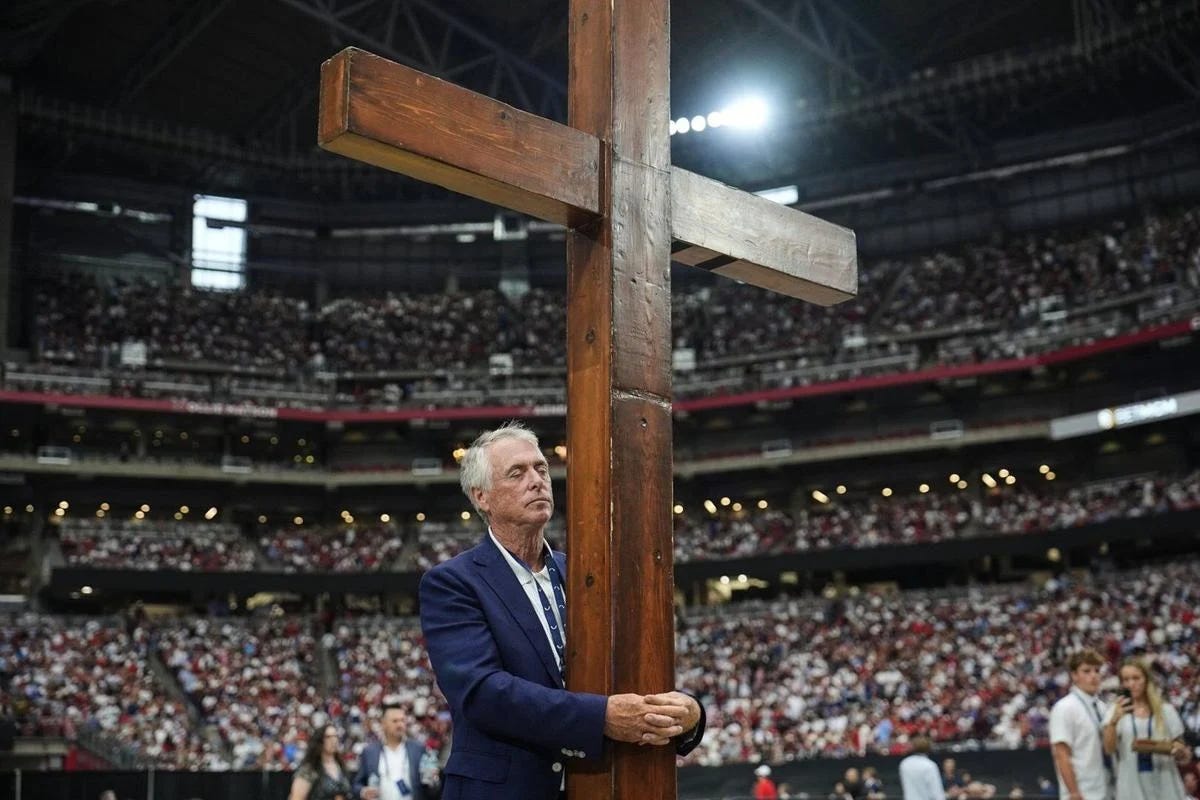
Because of this and its populist bent, there is no Evangelical “high culture.” Look at the Charlie Kirk memorial. It was all down scale bumpkin spectacle. No “high church” solemnity. Nothing elevating. It screamed to the world that his supporters are average Joes who just want a good laser light show and pyrotechnic display. All rock and roll and no hymns. Certainly, no organ. Everything about Evangelicals and their political thinking is low-brow populism and mass media generated. It is all geared towards the widest possible audience and the lowest common denominator. As a group they actively resist high culture and anything resembling a competing, culture producing elite in art, literature or media.
Politics Is Evil
We don’t need to belabour this point. But it should be noted that among Evangelicals there is a strong distrust of politics and politicians as something unseemly and corrupting. Good Christians stay out of politics. It certainly should not be seen as a vocation. And yet, they want politicians who will represent their interests, dominant among them are the social and moral issues like abortion and homosexuality. If it is unseemly for Christians as a community to have a set of political interests of their own, how in the world do you expect to develop the kinds of elites from within who can compete with other elites to advocate for and demand a hearing for the issues that matter the most to the community. Evangelicals are the disorganized mass that is continually manipulated and taken advantage of by a small group of organized elites who routinely play Evangelicals, gather their donations and votes, but do nothing for them. And if politics is not a vocation, how do you develop the kinds of intellectual foundations that help Christian political leaders navigate the halls of power in a way that is constructive and in keeping with their Evangelical faith? As a result, elites may emerge from the Evangelical community, but they won’t be obviously and distinctly Evangelical elites, even when they don’t disown their faith. Why? because there is little or nothing specifically “Evangelical” that guides them in politics, or business, or in the arts, or in academia.
Utilitarianism
This leads me into the final and related, but distinct aspect of this. There is a strong utilitarian bent to Evangelicalism, a bias for “what works.” It seems odd to say when one of the foundational affirmations of Evangelicals is that they want to base their lives on the truth of scripture. For example, the mega-church franchise model of establishing a growing church is largely justified by results. The church is growing. It must be a good thing. It just the Great Commission for the 21st century. No one stops to discuss whether or not a mega-church is a sound or even Biblical ecclesiastical model. Is there even a Biblical ecclesiology in Evangelicalism? Along similar lines, good business is good business. If it works and I am a decent person, then I am being a good Christian, right? I do what works. The idea that there might be a theology of Christian business practice and ethics is largely foreign to Evangelicalism.
Evangelicals generally want a theology that is practical and useful. They don’t want one that is nuanced and subtle. The problem is that to move in elite circles, you must deal with increasing levels of complexity and nuance. The typical Evangelical wants his theology to be clear, rational and unambiguous. They want their thinking to be stripped down and straight forward modernism. Objective truth. Clear morality. That sort of thing. They prefer the rationalism of modernity over the indeterminacy of post-modernism. The difficulty with this is that elites operate in the world of post-modernity. They are wrestling with the challenges to modernity. They embrace complexity and nuance. It is this same complexity that creates a demand for elites. Saying, “I lean on the simple truths of the gospel,” marks you out as not ready for the main stage.
Many Evangelical commentators and thinkers are biased towards “proof text” theology. Rather than develop a sound Biblical teaching on economics that takes scriptural concerns so as to develop them into a specifically Christian economic theory, for example, what you will often get instead is people arguing things like, “Why market capitalism is Biblical.” As we talked about above, you are borrowing from the thinking of the broader society so as to justify and approve of its use for Christians. “Why the US Constitution is based on Biblical teaching,” is not a product of someone who is aspiring to be an elite thinker. This is someone who is signaling his willingness to subordinate the Christian faith to some outside political or social philosophy. Here is the thing: real elites are adept at turning this against Christians. They will find and use proof texts to justify anything they want to do from deviant sexuality to mass immigration to tax policy. They will hollow out your own tradition and use it against you, using the same techniques you use. Not to say that this will render you immune, but if you begin from the ground up developing you own comprehensive philosophical tradition without trying to justify someone else’s ideas or policies, you have a much better chance resisting these influences. When you are forever reacting, you are always making rear guard actions. You are much more likely to adopt the thinking of the broader society uncritically and then try to justify it using the Bible. In contrast, real elites lead.
To conclude, I suspect that many who think of themselves as Evangelical will find this needlessly harsh and critical. Perhaps this is the case. But I am of the mind that this “tough love” is needed in large part because this particular moment has thrust Evangelicals into the spotlight. Frankly, they have shown themselves not ready for prime time. This is in large part because they have no real leadership class of their own, at least not one that is able to unify and fight for the interests of Evangelicals as a community, as a people with their own interests and their own existential desire to continue as a people. Maybe they are not a people. But they are a group. A political constituency. Right now, they serve, especially in the US, but this is also true to a degree in Canada, the interests of the state, of other elites who manipulate them for their ends. They are being used to further the interests of others because they lack sufficient cohesion and leadership of their own. If Evangelicals are going to develop “elites” they have to do so beginning within their own community. This is a multi-generational project. When you can be born into the Evangelical elite you will no that Evangelicals have succeeded in the task of elite formation. Far too frequently Protestant Christians, Evangelicals included, send our best and brightest off to public universities, places of elite production and networking, to go serve “the country.” In so doing they often must sever ties with their own community, turning their backs on their own. This is a problem not just for Evangelicals, but for Protestant Christians more broadly. Catholics, as Renn rightly notes, avoid this largely because they have built their own engines of elite production. Yes, many of these have been co-opted. But even co-opted they allow an avenue for Catholics to get elite degrees that then set them up for inclusion and influence among the national elites. You can also be born in elite Catholic families. This is not true of Evangelicals.
Stopping this trend, though, is about more than merely developing elite level Evangelical educational institutions. It is about a change in mindset and attitude. Today, Evangelicals exist as a largely disorganized mass that are manipulated and controlled by others largely because they organize and think of themselves as congregationalist, individualist, and populist. Additionally, they often find their core political identity from “the nation,” thus invariably putting their faith community into service to the nation. Self-conceptually they see their role as that of the loyal masses who are led by others. In this regard, this is what they end up getting. They don’t produce national leaders because they don’t think of themselves as the nation’s leaders.
Sponsorship Partners
FoxNSons Coffee

Steve Fox is one of “our guys” and he sells coffee. Good coffee. If you live in the US — sorry Canadians…too much government red tape involved in shipping coffee over the border…my supply comes hand delivered — he can ship you your coffee right to your doorstep. Go to the FoxNSons website now and use the promo code “kruptos” for a 15% discount.
Axios Fitness Coaching

JD is also one of “our guys” and he wants to help you get fit and stay fit for what is coming. Head over to Axios and get started today!
Necessarily harsh. Evangelicalism has been taken over by Fundamentalist Anabaptists, and it’s causing havoc.
The other week went to an event in DC with conservative elites in business and government. I was not surprised to see that almost everyone in attendance was Catholic.