
Thinking Theologically About Immigration
Some recent questions in my replies require longer answers than a mere "reply" can provide. One such query on immigration got me thinking and gave me an opportunity to think through this issue.


An interesting thing has happened since giving up Twitter for Lent. I have been finding much more inspiration for long form writing from your comments, questions and the back and forth exchanges I have been having on Substack Notes. Unfortunately, the stuff that actually pays the bills has been keeping me from writing this week. Hopefully the coming weeks provide more time at the keyboard. Responding to a Matthew Crawford piece on immigration, “Hospitality and the Political,” one of my subscribers, John Mullen asked the following question after reading my Note reposting the article with commentary:
There is a lot going on in this question, and it is worthwhile beginning at the beginning. I will try to keep this focused and avoid chasing down every rabbit hole that will inevitably crop up when burrowing deep into an issue. Many things will have to be left unsaid, for now. But let’s try to sketch out a Christian framework that can help you think through this problem as a Christian. But in the end, the answer is likely going to be: “It depends.” I know this is not the answer most will want to hear, but there it is. Immigration has become one of these litmus test questions where one must have a definite opinion and that opinion must be made to fit a predetermined political stance. Give the wrong answer and you are betraying the movement. But I see people, Christians, regularly torqueing scripture to arrive at a pre-determined political opinion on both sides of the debate.
As we will see, there is not a once and for all definitive answer, either practically or morally to this question. Immigration, especially mass immigration, always exacts a cost, on the leaving society, on the receiving society and on the immigrants themselves. This does not mean that there are not times in which it is the right thing to do, whether for practical or moral purposes. The task I have set for myself here is to build a rough framework for the Christian to both think about himself and his people and to work through how best to think about and understand the issues involved with immigration and if there is a situation where one would answer “yes” to the above question.
The first thing that we must clarify is this issue of “my country” raised by John. For the unbeliever this is perhaps a simpler answer. But for the Christian this answer will be different than it would be for the unbelieving person living down the street from him. What do I mean by this? Christianity is not an individualist faith. It is not merely a part of your life, the spiritual component of an otherwise full and rich life. You have your career, your family, some community involvement, the gym, and then to round everything out, you go to a church that “meets your spiritual needs.” But this is not what the Christian faith is. It may be what it has become in our consumer oriented western society: just another product designed to meet a need in our lives. But this is not what faith in Christ or the church actually is, what it is supposed to be in practice. We must understand that while salvation is personal, it is never individual. The Christian faith is not a product. We are not buying into a set of ideas. Both salvation and the life of faith are always communal and covenantal. When the individual and his wants and needs are emphasized, or even prioritized, we miss many central characteristics and aspects of God’s saving work. One of these is the Kingship and Kingdom of God.
Becoming a Christian is an inherently political act, but not in the way you might first think it is. For many, being Christian is synonymous with a certain political ideology or party affiliation. I hear people use the words “Christian” and “conservative” almost interchangeably, sometimes switching back and forth between the two multiple times in short periods, especially when speaking. A good Christian is seen as also being a certain type of “family values Republican.” They are the same thing, part of a cohesive whole for many people. Many others see Christianity and support for “free market” policies to be roughly equivalent. They often struggle to see that there is another whole subset of Christians who understand that the Christian faith is the vital core of liberal progressivism. Progressive Christians are horrified by conservative Christians and conservative Christians are equally shocked by the progressive Christians. Both often fail to see that they both have subordinated and domesticated their Christian faith to the dominant political powers of the day. They have both bent the knee before some version of the state religion. Very often that state religion in the west wears Christianity as a skinsuit. There are both conservative and liberal versions of this.
This is not what I mean when I say that the Christian faith is inherently political and that becoming a Christian is a political act. Being a Christian means that you are part of a people, a nation, distinct unto itself.
“But you are a chosen people, a royal priesthood, a holy nation, God’s special possession, that you may declare the praises of him who called you out of darkness into his wonderful light.” 1 Peter 2:9
We are God’s people. The implication of this is that we as the church are a nation without a single distinct homeland. Additionally, every act of conversion is form of immigration. You are immigrating from the kingdom of the world, dominated by Satan, by the “powers and principalities,” to the Kingdom of God. Satan’s offer to Jesus was real:
“Again, the devil took him to a very high mountain and showed him all the kingdoms of the world and their splendor. ‘All this I will give you,’ he said, ‘if you will bow down and worship me.’” Matthew 4:8-9
This was within his power to grant. It is still within his power to grant. Many, Christians included, are tempted by this offer. There is much that can be said, and debated, about this, but it is clear that there is something about earthly kingdoms and their power and wealth that is connected to Satan’s rebellion against God, his desire to replace God as the THE power in the universe. There is a reason why power and wealth are so corrupting. God’s saving work is properly understood within this cosmic battle of the devil’s rebellion again God and God’s answer to that rebellion in Christ.
Many think of salvation on entirely personal terms. The problem is me and my sin. My sin is keeping me apart from God and preventing me from entering heaven when I die. Or something like that. But believe it or not, this is not the main reason or category through which we should be thinking about salvation. Technically, salvation is not really about us at all. It is about the glory and greatness of God as King:
“Therefore say to the Israelites, ‘This is what the Sovereign Lord says: It is not for your sake, people of Israel, that I am going to do these things, but for the sake of my holy name, which you have profaned among the nations where you have gone. I will show the holiness of my great name, which has been profaned among the nations, the name you have profaned among them. Then the nations will know that I am the Lord, declares the Sovereign Lord, when I am proved holy through you before their eyes.’” Ezekiel 36:22-23
Even the love of God is not first of all about us who are loved, but rather about the greatness and glory of the God who loves. From beginning to end, salvation is about God. We are merely beneficiaries of the love of God. These are great blessings, don’t get me wrong, but they are first and foremost about God who gives the gift of grace and not us who receive that gift. In Jesus’ own words:
“After Jesus said this, he looked toward heaven and prayed:
‘Father, the hour has come. Glorify your Son, that your Son may glorify you. For you granted him authority over all people that he might give eternal life to all those you have given him. Now this is eternal life: that they know you, the only true God, and Jesus Christ, whom you have sent. I have brought you glory on earth by finishing the work you gave me to do. And now, Father, glorify me in your presence with the glory I had with you before the world began.’” John 17:1-5
Why is this important for the subject at hand, immigration? Because salvation is at its core, political. There is the true King, the Creator of the universe, the earth and all that is within it; and there is the usurper king, the devil, the angel who rose up in rebellion against God, dragging the whole creation and eventually humanity with it, into bondage, into slavery, not just to “sin” as an abstract concept, but to himself as the power behind sin and evil. When Jesus recruited Paul, he framed the task he was giving him in these terms:
“‘I am Jesus, whom you are persecuting,’ the Lord replied. ‘Now get up and stand on your feet. I have appeared to you to appoint you as a servant and as a witness of what you have seen and will see of me. I will rescue you from your own people and from the Gentiles. I am sending you to them to open their eyes and turn them from darkness to light, and from the power of Satan to God, so that they may receive forgiveness of sins and a place among those who are sanctified by faith in me.’” Acts 26:15-18
Paul is commissioned to be on the front lines in this battle between God and the power of Satan, under whom they are now in bondage, so that they might be freed and returned to God, the true King. It is a battle between kingdoms and dominions. We are the foot soldiers, the pawns, but also the prize and the beneficiaries in this conflict. It is a cosmic, spiritual battle being waged in the material realm. This is why Paul says,
“Put on the full armor of God, so that you can take your stand against the devil’s schemes. For our struggle is not against flesh and blood, but against the rulers, against the authorities, against the powers of this dark world and against the spiritual forces of evil in the heavenly realms. Therefore put on the full armor of God, so that when the day of evil comes, you may be able to stand your ground, and after you have done everything, to stand.” Ephesians 6:11-13
The enemy is the usurper king, the devil and the spiritual powers who support him in his rebellion against the true and living King, God the Creator, our Redeemer. We are not fighting people. They are not the enemy. They are prisoners of the enemy who need to be liberated for the glory of God. Here is the key point. They are being set free from the usurper king, so that they can be returned to the true King as his possession. Paul frames salvation this way:
“For he has rescued us from the dominion of darkness and brought us into the kingdom of the Son he loves, in whom we have redemption, the forgiveness of sins.” Colossians 1:13-14
Our work on God’s behalf in this effort could be characterized in terms of engaging in rescue missions where we go into enemy territory and bring back those who are imprisoned there so that they be free from that bondage to live now in the Kingdom of God, to be part of his royal priesthood, his holy nation. Salvation liberates us from he who presides over the kingdoms of the world, so that we can once again be under the rule and dominion of the true King.
The import of all this is that, properly understood, the church community must always be thought of first and foremost as its own nation. The church is a people, an ethnos spreading through conversion as well as passing the faith down through the generations covenantally. Every people has its own stories, its own founding myths, its own belief system. Conversion to Christianity involves a process of repenting from one’s previous story, so as to embrace God’s story of his work among and for his people. We might call this a form of “narrative suicide.” It is part of the dying and rising process.
This is the essence of what discipleship is about. It is us as a community expending the effort to enculturate newcomers and children into what it means to be part of the people of God, to be a royal priesthood, a holy nation with God as our King. Part of the essence of who we are is the investment of the energy and resources of the church community in this process of Christian enculturation. We are disciple makers. If this sounds a lot like what people expect will happen when people immigrate from one country to another, that is because there is a similarity. In some ways, everyone who comes to Christ is a “refugee” fleeing the kingdom ruled over by the powers and principalities to come live in the Kingdom of God under his Kingship.
Because we are our own nation, Christians are never truly at home among the earthly kingdoms within which they live. When someone asks you, “Who are your people?” or “To what nation do you belong?” you tell them that you are a Christian who belongs to the Kingdom of God. You might clarify that by saying that this Kingdom is instantiated primarily in and through the church, the community, the nation of believers. This is a global community. A single people. That said, this nation, spread out over the whole earth, will take on the unique flavour and character of the land and people groups within which it is instantiated. This is completely normal. We see this in regular, earthly, powers too. A Californian is different from a Texan who is different from a Virginian who is different again from a New Englander. But all would consider themselves “American.” It is the same with the church. Here is rub, the point where many will bristle when it is said out loud. A Christian who lives in England, Germany, Russian, China, Africa or India are your fellow citizens in the Kingdom of God. They are more your fellow citizens than are the unbelievers who live down the street from you. You are never an American, or Canadian, or German first of all, you are a Christian first. You are a Christian who happens to reside in Canada. To become a Christian is fundamentally an act of treason against the nation state you are leaving to join the nation of God, even if physically you remain in exactly the same location.
At the same time, while the Christians who live half way around the world are a part of your people, have citizenship in the same kingdom as do you, they are not your neighbours. A neighbour is someone who has real proximity to you, whether they are part of your people or not. The command to love your neighbour as yourself means loving the non-Christian living on your street even though he is not one of your people. As a Christian who happens to reside in America, you can care deeply for your neighbours, and have a strong appreciation, affection, love even, for the land in which you live, but when push comes to shove, your citizenship is in the Kingdom of God and you are under the Kingship of God. But this love you have for your neighbour means that you do not want to advocate for policies, like mass immigration, that will do him real harm, at least not without his participation and consent.
This is why the church should rightly be seen as a political threat to any nation within which it resides. This is one reason why the “powers and principalities” work relentlessly to co-opt, subordinate, domesticate and ultimately neuter the Christian community politically, to prevent it from faithfully pursuing its own existential future, its primary loyalty to God and to God alone as its King. As an aside, this is why you shouldn’t be flying the national flags of earthly kingdoms within a worship sanctuary or anywhere on church property for that matter. Nor should you sing national anthems during worship or at church events. If anything, the church should have its own flag and its own anthem. I mean, this is part of the function that the recitation of the Apostle’s Creed takes in worship, so there is that.
We could spill vats of ink writing thousands of words discussing the relationship between the church and state in places where the church, God’s holy nation, is in the minority, when they are the majority or they dominate the elite class within a geographic boundary in both a majoritarian or minoritarian situation. But in all situations, and this is where things most tend to go sideways, is that the church should always be careful about maintaining its own borders. Just because you are in a majority position in society and occupy the position of the elite class, does not mean that the church can relax and just assume that everyone will be enculturated fully into the Christian faith via osmosis. “Cultural Christianity” might be able to enforce certain attitudes and behaviours beyond the borders of its own community when in the dominant position in society, and this might happen without much effort because people want to imitate their elites, but this does not mean that the church community should therefore abandon the careful defense of its borders. It should guard the sacraments. It should guard membership, that is citizenship. And it should still engage in the intensive societal work of enculturating covenant children and new believers into the faith. It should not shy away from spiritual discipline, even, and especially, when applied to elites. Even the president, the prime minister, the dictator for life, or the king should still submit themselves to the spiritual authority and discipline of the community of believers. Especially when the church is dominant, it is good for society as a whole to see their elites submitting to and embracing spiritual discipline as a necessary part of being a citizen in the Kingdom of God.
A borderless, cultural Christianity, where the church assumes that everyone within a political boundary is Christian because Christians are politically dominant, is not that different from today’s church growth movement. How is this? It is a model that seeks to remove the cultural distinctiveness of the church so as to make it less threatening or intimidating to potential newcomers. The idea is to remove all the barriers to entry that would keep people away. Functionally, what this means is that merely by attending worship on a Sunday morning, one now belongs to the church. The idea is that once they are there, worshiping on Sunday, they will want more. Then you can introduce them to true discipleship. The problem is that this is a “bait and switch” tactic. In practice it doesn’t really happen, not the way that it should.
Most large churches these days are built on the model of open borders and mass migration. Get them in the door and they can now be counted as citizens of the Kingdom of God. These church organizations are true believers in growth through mass immigration, but not in the way you think. Mass immigration is often thought about mostly in terms of people movements where they come from outside your country to live in your country. But this is not the only vector for migration. The other is internal, people moving from one region of the country to other regions in large amounts over a short period of time. We will often see stories talking about “Canada’s Five Fastest Growing Cities” or some such. Generally this is looked on as a good thing, a place where economic activity and growth is taking place. Perhaps these might be places to go if one were looking for economic opportunity?
This type of internal people movement, especially in large geographic countries, may be less disruptive than migration from foreign countries, but it is still disruptive. It can strain public services like schools, hospitals, police and fire. It will affect the culture of the destination community. Think of the impact that immigrants from California have had on Texas. It can change things politically as well. The phenomenon called “The Big Sort” is real. When teens from Toronto are hanging out at the mall in your small city because their families just immigrated from the GTA, you can feel the difference. They don’t belong. They are not like us, even when they look the same. Big cities and small cities are not the same. Just because mom and dad can now work remotely, enabling them to keep their jobs and take advantage of the lower real estate prices in an outlying region, does not mean they are a cultural fit in their new location.
Why does this matter for churches? Well, when you study the fastest growing churches in the United States, the 150 or so largest, only 6% of them are located in counties that had negative population growth. Only 13% of American counties saw their population rise by 10% or more from 2010-2020. But 59% of the fastest growing large churches are located in one of those counties. The implication of this is that most churches that are growing fast are growing because they are taking advantage of internal migration and the social dislocation it causes. People who are in a new community who are looking to make connections, who are dealing with the emotional toll that moving to a new location exacts, it turns out they are remarkably receptive to trying out one of these newer, faster growing churches.

When you bore into the church growth movement much of the quantitative growth, while real, is somewhat illusory, as the growth is driven by immigration, and only secondarily by conversion. I am sure that in this period of dislocation that many who otherwise had no previous contact with the church or the gospel message are now making a faith commitment — and this is a good thing, let that be heard — but much of the growth can be accounted for as a downstream effect of migration. It’s growth through open borders and immigration. The jury is still out on the long term cultural impact of these kinds of open border policies for the church, but the initial returns are not encouraging. It seems that the pull for the churches to adopt the sensibilities of the broader culture has been strong and many have been adjusting their stance on various issues under the guise of being more “pastoral” to these newer church members.
There is no denying that immigration exacts a toll on the society that is receiving them, whether the effects are cultural, political or economic. These are heightened when the quantity of immigrants grows and the initial cultural differences are more extreme. There is a marked difference between the ability of a person from one country of European heritage immigrating to another country of European heritage to assimilate, than those from a country or region with a very different ethnic, religious or cultural history. A recent Danish study found that almost exclusively, only Europeans were net economic contributors, even over several generations.
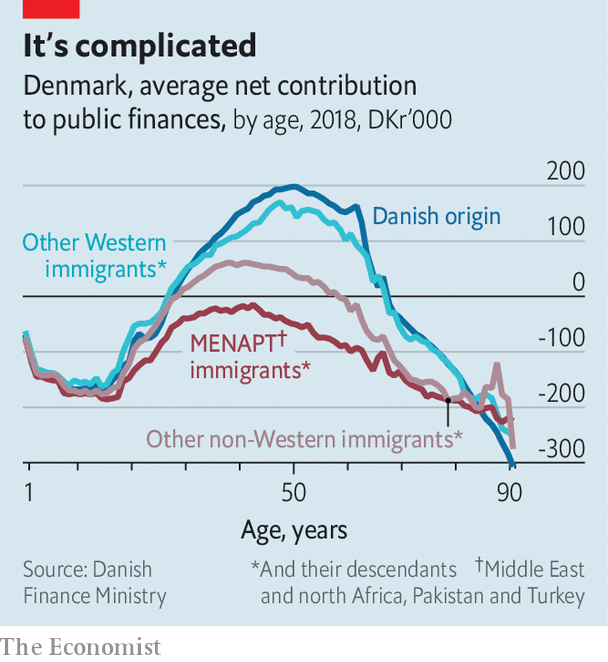
This does not necessarily make mass immigration morally wrong. But trying to sell it as a magic, hit the easy button, cure all for a host of issues like declining birth rates or to drive economic growth have all been largely been shown to be “snake oil.” In reality, mass immigration has exacerbated most of the problems that it was supposed to solve, while creating a lot of social upheaval, dislocation, strain and tension. Additionally, we know that one significant policy driver for mass immigration was as a tool to keep wage costs down in certain key segments like agriculture and certain service industries, like fast food restaurants. The fancy term for this is '“wage arbitrage.”
This is not to say that under the right conditions, with a high degree of honesty from our leadership class — as opposed to the wishful thinking, outright deception, and propaganda manipulation under which most mass immigration happened — that a moral case could not be made to the receiving society. For example, and lets use an edge case here to make the point, to take up the question of my respondent who sparked my writing of this piece, that let’s say that there are 10 million people approaching our border, but they are coming, being driven by a marauding force towards us. Perhaps the right thing to do in this situation is to receive the 10 million and then drive back the marauding force. As a society, we know that we are going to be undertaking huge sacrifice that will likely have a negative affect on us economically and socially for some time. But we know, on balance, it is the right thing to do. The political elite were honest with the people and on their behalf made a choice that they knew, in spite of the costs, was the right thing to do.
In other situations, even without the marauding force, it still be the right thing to do, even if just for economic reasons. Internal migration often happens this way, especially for resource exploitation. A recent example would be the positive economic impact that fracking for oil had on many regions in the US. It drove growth by drawing people to the region for the job opportunities. These are, technically speaking, “economic migrants.” But we think nothing of it when the immigration is internal. But it might be asked, was this not the easier path. Were there really not enough local people to be trained and brought on board to fill the job opportunities? Or was it just easier to bring more qualified people — but maybe not fully qualified — from outside the region, depriving opportunities from the locals? Again, the answers to these questions are not always simple.
Migration and people movement are the stuff of empires and they were used to conquer and occupy the new world. We call them “settlers,” and perhaps there is a moral difference between them and mere “migrants,” but immigrant-settlers were still employed as an expedient choice. The west needed to be occupied. And in quite a number of instances, the identity they brought with them has persisted over time, especially when they moved from one place in large numbers to all settle in close proximity. There are many hyphenated Americans and Canadians. Was it morally wrong, immoral, to use a large number of foreign migrants to settle the west? What is it that makes today’s mass immigration so wrong? Is it the downstream negative effects? Or has it been the fundamental dishonesty about those effects, or even the possibility of these effects might be experienced? Is the real immorality the lack of truth telling, knowing that telling the truth could result in electoral disaster? Or has the real immorality been an elite that has ignored its own people to enact policies that have been harmful, that did them by illegal means when they knew they would never be able to do it legally? Has it been the fact of immigration, or that native populations have endured propaganda and even criminal sanctions for noticing and objecting to it? Or is it both? Positive examples that worked out in the end over time can be found. But initially, all large waves of migrants cause social disruption, even when the migration is internal. Part of the social stability of the middle ages came from the laws that prevented the movement of people. Part of the dynamism of the American context can be attributed to the high degree of geographic mobility, people going where the opportunities are. The downside is the fraying of the social fabric. How many people really know their neighbours these days?
One last point I want to consider here is the frequent accusation by Americans on the political right is that when it comes to immigration, everyone outside of America is completely “cucked” when it comes to immigration. Global immigration across the west is largely, but not exclusively — Britain has a history with immigration tied to the wind down of its own empire. As does France. — due to the downstream effects of the Global American Empire. Whether it has been people dislocated by “red lines” in Syria, the “Arab Spring,” or the war in Afghanistan, or the demands of multinational corporations benefiting from the Pax Americana looking for cheap labour or easy market development, or merely the signaling of globalist elites of their obedience to the progressive sensibilities of Blue America — I mean, why are there “Black Lives Matter” protests in European countries with little or no African descended populations? — trying to be more progressive than their American masters, that much of the impetus that drives mass immigration can be traced back to the demands created by a global imperial hegemon. This is something more or less obvious to thoughtful commentators living outside the US, than it is to many Americans. Most mass immigration is downstream from the reality of the GAE.
So, again, the answer to John’s question is, “It depends.” Each situation is different. One answer might be to put up the wall, string out the barbed wire and man the machine gun nests. Another situation might actually be to welcome them in knowing the costs that will have to be endured by doing so. This is the problem that we face. These are challenging decisions for even wise and honest leaders. Our leaders on the other hand are frequently bad actors, greedy, dishonest and willing to sell out their society to provide marginal gains for the people who fund their campaigns. Will 10 million immigrants guarantee me a perpetual majority in the House? If not 10, would 20 million do the trick? For many, the fact of mass immigration is one thing. If there was genuine moral reasons for doing it, people might have embraced the sacrifices necessary if presented to them honestly.
Instead, much of it has been done by venal leaders while the costs were overlooked, or worse, while we were propagandized that this was the best thing ever. And when all of our fastest growing churches have been built by capitalizing on people migrations, one wonders if anyone in our leadership class are willing tell us the truth. How many of our own Christian leaders actually understand the fundamentally political nature of kingdom where their primary citizenship belongs? I think most of our leaders know that most people like safe, comfortable communities where they know everyone. Most churches, when push comes to shove, don’t really want to grow. I mean, they like the idea of spreading the gospel and the church being full of newcomers giving themselves to Christ, but not with the reality of dealing the disruption to their thick community. This is why most fast growing churches are, on the whole, thin communities where people have shallow connections to one another. Nobody really wants to do the difficult work of discipleship. They would just rather let the culture of the community do it by osmosis. Its not that much different when it comes to regular immigration. People benefit from stable, enduring social bonds. They don’t want that disrupted. The case for immigration, especially mass immigration, if honestly presented has to be a lot more compelling than the one that is currently being made if people are going to give up their safe, stable communities and the economic hardships that often come with mass immigration. Unless there are truly compelling reasons, most will say no.
Sponsorship Partners
FoxNSons Coffee

Steve Fox is one of “our guys” and he sells coffee. Good coffee. If you live in the US — sorry Canadians…too much government red tape involved in shipping coffee over the border…my supply comes hand delivered — he can ship you your coffee right to your doorstep. Go to the FoxNSons website now and use the promo code “kruptos” for a 15% discount.
Axios Fitness Coaching

JD is also one of “our guys” and he wants to help you get fit and stay fit for what is coming. Head over to Axios and get started today!
Do you have thoughts on the concept of natural affections?
Important conversation.
When the children of Israel were entering the Promised Land, God told them to completely wipe out the inhabitants. Why? Boil it done and the cultures were incompatible. One would corrupt the other if allowed to mingle; and it was not going to be the good culture dominating the bad culture. You cannot have open borders and maintain a national culture, ever.
Immigration worked in the past because we are a large country and immigrants dispersed among the population, and assimilated. More importantly, the immigrants were of a similar Christian culture and assimilated easily, with only language as the primary barrier. Later came Hispanic immigrants with a very non European culture and language. However, they were Christian background with a shared understanding of ethics, religion and government, generally. Assimilation happened quickly where they weren't closely congregated.
The latest wave of immigrants are culturally incompatible, particularly Islam. More than that, they have no interest in assimilation and expect to be accommodated. Additionally, Islam is a religion of conquest and has every intention of subjugating the nations it invades; and invade is the correct term.
Open borders in this era is a death sentence on the host.