
The Story of God and Cain
An interesting piece was brought to my attention: a reflection on the so-called "Cain and Abel" story. I was going to respond with a note, but there is enough here to warrant a short meditation.

Friend of this publication, The Black Horse, brought this interesting and thoughtful piece by Maven Politic to my attention:
I am not going to rehash everything he said here. It’s a well written piece and his representation of four traditions of interpretation is fair and a good overview of each. My only quibble might be that Rene Girard, while insightful in his thesis of mimetic violence and the scapegoat mechanism is not what I would consider a proper “Christian” interpretation of the text. I will endeavour here to do just that, offer a Christian reading of the text. While I am generally confident in my interpretations of scripture, I would not wish to propose mine as THE Christian way to read the text. This is a story that has such a tradition of interpretation it is almost impossible to simply just read the text. But let’s make an attempt at doing so that can hopefully remain accessible to a wide audience.
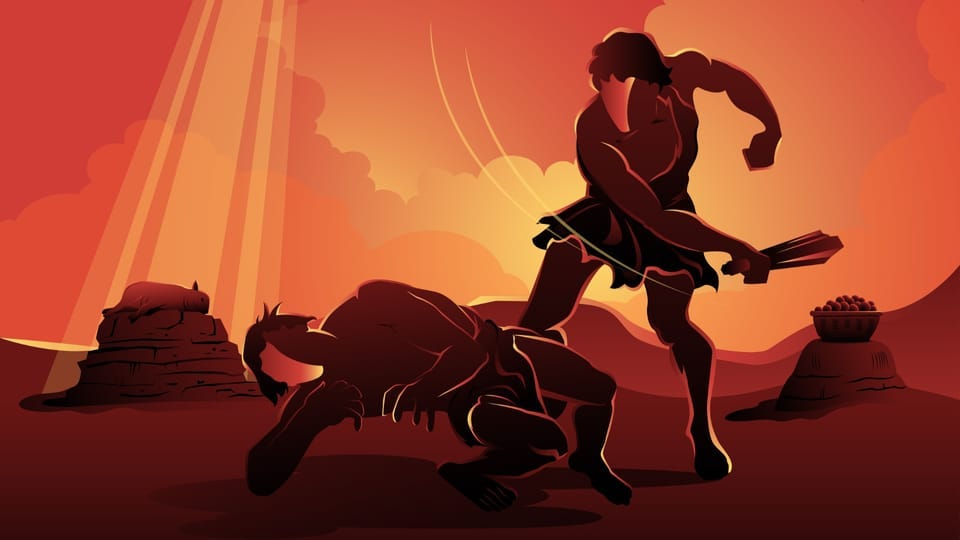
It is interesting to note at the start that this is a story that happens between God and Cain. Abel is almost incidental to what happens. He is necessary to a point in order to drive events forward, but as his name suggests, he is “vapor” or “nothingness.” Generally, Hebrew narratives revolve around the interplay of two characters who occupy the main stage at the same time. Because we as human beings like to place ourselves at the centre of the narrative, we generally focus on the human actors as the main characters, but if we think of God as the main character here, or at least one of the two persons that the tale is about, the story itself changes dramatically.
Cain is the firstborn. He is given his name, meaning “to get” or “to create” because of Eve’s pronouncement that “With the help of the Lord, I have brought forth a man.” Eve is claiming a kind of secondary act of creation. Then comes mister afterthought, the nothing man, Abel. It is interesting that throughout the book of Genesis, and the grand sweep of the scriptures for that matter, that first born sons do not fair well. Ishmael. Esau. Judah. Esau works the soil. Abel tends flocks. A division of labour. Nothing more. The text assigns no moral valence to either task, nor does it say anything about the two men in terms of their moral or spiritual condition that might indicate ahead of time why God received the sacrifice of one and not the other.
Here is the most important turning point in reading the text. This is a story about God. This is the same God that will test Abraham by demanding he sacrifice the son of the covenant promise, his son Isaac, for no other reason that it was demanded of him by God. We must also read it in the light of a book like Job, where Satan, whose name means “the Accuser,” points his finger against Job:
9 “Does Job fear God for nothing?” Satan replied. 10 “Have you not put a hedge around him and his household and everything he has? You have blessed the work of his hands, so that his flocks and herds are spread throughout the land. 11 But now stretch out your hand and strike everything he has, and he will surely curse you to your face.”
Job 1:9-10
What has Job done? Nothing. In fact, he was “blameless and upright.” And yet when the charge was leveled against Job that he was only this way because God had put a hedge around him, he allowed Job to be tested. As the suffering that Job was forced to endure deepened, his wife got the to heart of the matter:
9 His wife said to him, “Are you still maintaining your integrity? Curse God and die!”
10 He replied, “You are talking like a foolish woman. Shall we accept good from God, and not trouble?”
In all this, Job did not sin in what he said.
Job 2:9-10
The Lord is a holy God. He remains separate. Above and beyond the ways of men. Beyond our comprehension. God judges us. We do not judge God. For was this not what Cain was doing with this new knowledge that had come to humanity? When God did not look with favour on Cain’s offering, what was his response? He was angry. What is left unspoken is that he was angry at God. He was judging God for having shamed him in front of his brother. Now that we know good and evil, we develop ideas about what God should and should not do, how God should treat us. But God is God. Things are right or wrong because God says they are. God reminds us in the book of Job who is who and the nature of the moral hierarchy:
6 Then the Lord spoke to Job out of the storm:
7 “Brace yourself like a man;
I will question you,
and you shall answer me.8 “Would you discredit my justice?
Would you condemn me to justify yourself?
9 Do you have an arm like God’s,
and can your voice thunder like his?
10 Then adorn yourself with glory and splendor,
and clothe yourself in honor and majesty.
11 Unleash the fury of your wrath,
look at all who are proud and bring them low,
12 look at all who are proud and humble them,
crush the wicked where they stand.
13 Bury them all in the dust together;
shroud their faces in the grave.
14 Then I myself will admit to you
that your own right hand can save you.Job 40:6-14
And so when God presses Cain we understand what is happening against the backdrop of the testing of God. God has removed the hedge around Cain and he immediately began to fail the test by being angry and ashamed. God challenges Cain:
“Why are you angry? Why is your face downcast? 7 If you do what is right, will you not be accepted? But if you do not do what is right, sin is crouching at your door; it desires to have you, but you must rule over it.”
Genesis 4:6b-7
This is the heart of what can be called the “desert experience.” What will you do when you are alone, when everything goes against you, when you have every opportunity to judge God, to shake your fist at him and curse him? What will you do? God creates a crisis for Cain. This establishes a pattern. It is why these stories are written, not so much to explain the past, but to tell us why things are the way they are in the present. Sin is now in the world and mankind has two paths he can take. The path of life and the path of death. Sin is the path of destruction and death. It desires to destroy you, to consume you. Cain can engage the struggle to master sin, to master his rebellion against God and to do what it right. Or he can give himself over to it.
The heart of human life in the world “east of Eden” is the choice to do what is right, to do those things that will make us right with God and with each other; or we can choose sin. We can choose to judge God. Sin is an aggressive force in the universe. We live in a world that no longer provides an easy bounty for us. Ours is a world of scarcity. Ours is a world where we will be tested, by sin, but also by God. There will be times when he will intentionally withdraw his presence or make demands of us, demands that will have us judging God and lashing out at those around us. Will we do the work of seeking God in such an environment, when our hedge of protection has been taken away, when God is not receiving our offerings? This is the question.
The answer to this comes in the life, death and resurrection of Jesus, the Christ, God become man for our salvation. In this, he left with us the great gift of the indwelling of the Spirit to reveal that which is now hidden “in Christ”:
16 So I say, walk by the Spirit, and you will not gratify the desires of the flesh. 17 For the flesh desires what is contrary to the Spirit, and the Spirit what is contrary to the flesh. They are in conflict with each other, so that you are not to do whatever you want. 18 But if you are led by the Spirit, you are not under the law.
19 The acts of the flesh are obvious: sexual immorality, impurity and debauchery; 20 idolatry and witchcraft; hatred, discord, jealousy, fits of rage, selfish ambition, dissensions, factions 21 and envy; drunkenness, orgies, and the like. I warn you, as I did before, that those who live like this will not inherit the kingdom of God.
22 But the fruit of the Spirit is love, joy, peace, forbearance, kindness, goodness, faithfulness, 23 gentleness and self-control. Against such things there is no law. 24 Those who belong to Christ Jesus have crucified the flesh with its passions and desires. 25 Since we live by the Spirit, let us keep in step with the Spirit. 26 Let us not become conceited, provoking and envying each other.
Galatians 5:16-26
It is the Spirit of God dwelling within us who does battle on our behalf to do what Cain was unable to do. We desire sin. We want it to master us. But when we acknowledge this within ourselves and that we are incapable of doing anything about it on our own, accepting our great need for salvation, putting our faith in Christ, with this faith, God pours into us his Spirit who then does battle with our flesh. We want to sin. The Spirit battles so that we do what is right. Because of the Spirit, we succeed where Cain failed. Since we live by the Spirit, we keep in step with the Spirit. We are able to be who we are “in Christ.” A new creation. Resurrected. Children of light.
This relationship, though, is not one that is merely “vertical,” that is, between us and God. It also restores a right relationship with our brother whom we resent because he isn’t being tested by God. The correct response to your brother is not to kill him, but to protect him. Yes, you are your brother’s keeper. You know that road. You have been down that path and know where it leads. Cities. Walls. Violence. Plunder. Theft. Destruction. But it all leads to Babel, to rebellion, to the desire to build a city, a tower, so tall that it reaches to the heavens. We can make a name for ourselves and stand side-by-side with God. Or above him.
The alternative is to be our brother’s keeper and not our brother’s murderer. To trust that God himself is preparing a city for us. Again and again and again the story of humanity is one of failure, failing God, failing our brother, failing ourselves. The world is the way it is because we judge God, we refuse to trust him, we let sin have its way with us and we murder, oppress, exploit and steal from our brother. But there is a better path. That of the cross. That of faith. That of the narrow path.
Sponsorship Partners
FoxNSons Coffee

Steve Fox is one of “our guys” and he sells coffee. Good coffee. If you live in the US — sorry Canadians…too much government red tape involved in shipping coffee over the border…my supply comes hand delivered — he can ship you your coffee right to your doorstep. Go to the FoxNSons website now and use the promo code “kruptos” for a 15% discount.
Axios Fitness Coaching

JD is also one of “our guys” and he wants to help you get fit and stay fit for what is coming. Head over to Axios and get started today!
Very helpful post. I do find it significant that it is Cain and his descendants who are protected by God (mark of Cain) and who build cities and crafts like music-making, smithing and so on. Can we conclude that God has a soft spot for those who do question him, that He recognises that it is the rebels (mutations in the context of evolution) that push humanity towards greater understanding, and so closer to deification?