
Party Politics and "The Political" Are Not the Same Thing
An abiding frustration of mine is that so many--even people I like--get the "friend-enemy" distinction wrong, apply it wrongly, muddle it up, and in so doing miss much of the potency of the concept.


I will say it straight out. When Carl Schmitt put forward the “friend-enemy distinction” as the definition of “the political,” he did not mean it in the way that you will most commonly hear it being applied: “reward your friends and punish your enemies.” You will not read Carl Schmitt saying this anywhere in his book The Concept of the Political. Why do people use it in this way? It is kind of cool to say “friend-enemy distinction.” Mostly, they are trying to make sense of today’s complex web of power interests in a way that is simple and straight forward. Well, they want a politics that makes sense and is also morally restrained, and Schmitt’s handy phrase does allow for it to be used as a simplistic heuristic. Unfortunately, to do so really robs the idea of its power.
There is one form of political thinking which asserts that all political activity should be governed by a set of rules, something akin to the “rule of law,” or a “rules based order,” that is, a set of principles which all participants are explicitly or implicitly supposed to follow. There are universal rules that apply always in every circumstance and everyone should abide by these rules. It is an ethical politics. People who think this way struggle when confronted with the complexity and the moral autonomy of the realm of political action, that politics makes it own rules, that is, it is governed by realpolitik. As Jacques Ellul argues in his work The Political Illusion, it was Machiavelli who first pointed this out most clearly. Politics is governed by its own rules and is not subject to normal morality. It must do what is most effective and efficient. Ellul argues that you must deal with the arena of politics as it is, not as you wish it to be.
This idea of rewarding friends and punishing enemies is an attempt to develop a “morality” for the autonomous realm of practical politics. It is an effort to impose a differing set of rules for politics, a different ethic. Instead of everyone being bound by a single unified set of rules — we will treat everyone like individuals and will reward all the same, regardless of political affiliation — what happens in this different ethic is that we no longer treat everyone the same. We hand out patronage benefits to our supporters. It is the way “machine politics” works. It is the way “tribal” politics works. We give our supporters rewards. We refuse those same benefits to our political opponents. More so, we will make things actively difficult for those who oppose us. We will harass them using the mechanisms of power. This will be an effort to force compliance. Once they are on board with our program, they will receive rewards. This is actually a different political ethic and not strictly a manifestation of the “friend-enemy distinction” as Carl Schmitt laid it out in spite of the surface similarities. Schmitt is arguing, perhaps contra Machiavelli, that “the state” is only properly constituted when it emerges from what he calls “the political.” Correctly understood, his is an argument for the proper ethical grounding of the state. He opens The Concept of the Political this way:
“The concept of the state presupposes the concept of the political.”
But before we dive further into examining the friend-enemy distinction in Schmitt and why this matters, we should take a few minutes to grasp Ellul’s assertion that the autonomous nature of politics makes the idea of ethical or religious politics an illusion. Once we understand this, Schmitt’s attempts to show that once the state is given the proper ethical foundation in the friend-enemy distinction, it is then free to act by necessity in support of that ethic.
As we just said, Ellul makes the argument that following Machiavelli, you cannot deal with the political in terms of the realm of the ideal, what should happen or what is the most ethical option; rather, you must deal with the world as it is and accept that you must do what is necessary in the moment. You must deal effectively with the necessities of reality as it is, not as you think it should be. Above all, a politician must be effective. Once this is acted upon, all states must adopt the same posture out of necessity. They too must effectively deal with political realities as they are. All states should be judged on effectiveness and by no other criteria. Ellul argues that what gives a state legitimacy is that it can effectively defend itself.
“In the present world the state is taken seriously only when it threatens or defends itself in a fight to the death against some grave danger to its existence.”
Powers that can effectively maintain themselves are legitimate. The legitimacy of a state results from two elements, the support of the people and recognition by other states as being a sovereign entity. Since the support of the people can and must be manufactured through some form of propaganda or patronage, the only real criteria for the legitimacy of a state is that it is recognized by other states as such. That is it. There are no ethical criteria for legitimacy.
When dealing with states governed by the necessity of being effective we must understand that in this reality law is not normative. When it comes to states, if facts or ethics collide with the law, the law will conform to necessity. When a state is led to apply force, that is, violence, it never observes the law. The police and military never observe the law and are functionally the same: they wield violence on behalf of the state. The differences between the two are illusory as both apply force for the state. Law does not restrain the state in the use of force. The idea that the police and the military submit to the rule of law is propaganda, a political illusion.
The slightest manifestation of independence is a challenge to the state’s monopoly on power, and thus on violence. The citizen cannot act to limit the power of the state, he is merely the object of state violence, which includes propaganda. If the citizen meaningfully challenges the power of the state to limit its ability to exercise violence, this immediately makes the citizen a partisan or militant. This is the primary argument that America’s second amendment, the so-called right to bear arms, is an illusion. It is meant to act as a threat. But it is not one that the state takes seriously, otherwise it would use its force to disarm the populace. They are allowed to maintain the illusion because this illusion that American gun owners are some form of partisans functions as a form of containment.
“To say that the state should not employ force is to simply say that there should not be a state.”
A state likewise cannot avoid war. A state that wishes to continue must assert its will to continue and this will conflict with the will of other states to continue. Sooner or later, this dynamic will result in conflict. There are no rules of war. The so-called rules of war only exist in peace time. In the middle of a conflict, they prevent victory. The only rule of war is that you must do what is necessary to win.
There can be no moral objections to the autonomy of the state. It is bound by nothing but its own necessity. The greater the power of the state, the more that moral values disintegrate. In regard to constitutional democracies or republics, these cannot offer any restraint to the realities of power. They are illusions.
“It is illusory to think that the means of applying power must be increased so that justice, liberty and truth can be attained and realized.”
When it comes to the state, there are no boundaries between what is right and wrong, just and unjust, true and false, good and bad.
“The effective boundary is then between what can and cannot be done.”
Before we transition to Carl Schmitt, let’s finish up with Ellul’s observation that the primary organizing reality of the state will then subordinate all other realities using the power of the state and the necessity of the effective use of power to achieve the objective of its primary organizing reality. For example, if a state is organized around the idea of achieving a certain material standard of living, all other realities will be subordinated to that one. If the organizing principle of the state is the vitality of its industry or the success of its largest corporations, then everything else must be subordinated to that. If it organized around a set of ideas or ideological commitments, then everything else will be subordinated to that. That will include the social life of the people, the emotional life of the people and perhaps more importantly, the spiritual and moral life of the people. The state, argues Ellul, will be organized around something. Everything else will then be subordinated to that reality. We then judge the state in how effective it is in acting for that reality. Everything else is an illusion.
Ellul argues that even in a democracy, the gaining and keeping of power follows its own rules. He asserts that we should approach politics without values, morality or virtue, to be honest about it and so avoid being cynical. To view politics through the lens of the spiritual or the moral is to have a very facile or superficial view of what is happening. Only the political significance of political acts should be considered. It is a romantic illusion to think that political affairs will be better if there are Christian men doing politics, good men who are moral and humane, men with real integrity. If you want to insist that your actions conform to the will of God, or Christian morality, or some such, you must know that you are not making a political decision but rather a religious one. You are subordinating the political to the religious. It might be good religion, but it will likely be terrible politics. You may be comfortable with that, but Ellul wants you to be honest about what is happening.
Political decisions should not be made on the basis of religion, the protection of liberty, justice or the rights of the person. When it comes to the state, all of these are mostly propaganda invoked to induce social conformity. The political actor speaking in such lofty terms is usually doing so to justify a political action made for political reasons. You must assume that he is twisting the religious or ethical in order to conform it to a political necessity, and in the process subordinating it to political demands. For this reason, argues Ellul, the people should generally be spared the reality of political necessity.
“If we believe—and we firmly believe it—that the individual has a spiritual life, a value, that man cannot realize except by the accomplishment of moral acts, then it is evident—and necessary—that there be a distance between political affairs and the individual.”
In this regard, and I think Ellul is correct here, that all forms of representative government with a broad franchise have a corrupting influence on the spiritual and moral life of the people.
“An individual can participate in political affairs, but he cannot claim that in doing so he is expressing or realizing himself to his fullest extent. The opposite actually takes place: the autonomy of the political machinery not only does not permit individual acts to influence its operation, but individual acts and motives become completely submerged within it with the result that the individual as such, simply ceases to be.”
So, if we accept Ellul’s understanding of the autonomy of the realm of the political, and that this realm operates by its rules, that of being effective, what is the point and the purpose of the state? What is it trying to do effectively? What should it be doing effectively? A state will accumulate and wield power. Why is it doing this? Understanding this helps us to assess and evaluate the legitimacy of the foundation of the state. I would argue that democratic mechanisms generally mask what it is that the state is actually doing and what it actually exists for, in contrast to what most think that it is doing or should be doing. Understanding this helps us to properly evaluate the “effectiveness” of the state. This brings us to Schmitt. Again:
“The concept of the state presupposes the concept of the political.”
Schmitt sets out to make the argument that a proper understanding of the function of “the state” presuppose that we have a proper understanding of “the political.” So what is this thing called “the political?” Schmitt argues that we must separate out the political from other categories of meaning. It is these other categories that potentially act as organizing principles for the state. To emphasize this, he draws on several examples. One such is “morality,” which is organized around the binary of “good and evil.” Another would be aesthetics, which is organized around “the beautiful and the ugly.” The third he lists is economics which is organized around “profitable and unprofitable,” or perhaps in today’s discourse, “line go up and line go down.”
In the “political” that distinction is between friend and enemy. What denotes a friend is someone who has an intense association with you. You have an existential desire to continue that association. The basic question that divides the friend and the enemy is that the enemy represents a threat to that desire for continued existence with your friends. The enemy in the political sense does not have to be evil or ugly or even a competitor. The enemy is nevertheless the “other,” the “stranger.” The enemy merely has to be different, something alien to “us” and “our way of life.” You don’t necessarily have to be in conflict for an enemy to be an enemy, just that the threat of conflict is there.
In the liberal era we have been taught that it is wrong to divide the world in such a way. It seems archaic and maybe even barbaric to the liberal mind. But whether we like it or not, the world invariably ends up getting sorted into friend and enemy. Politics is the expression of this friend-enemy distinction. This distinction can be either potential or actual. Until a specific conflict develops, whether war or revolution, this distinction remains a potentiality that is only actualized when conflict breaks out. The properly constituted state, argues Schmitt, is the institutional expression of the organized desire for a people to continue their existence. That is its heart and core. The role of the state is the general welfare and continued existence of a specific people who have self-identified as a people. Much of the language of politics has no real meaning or sense unless you know exactly who is to be affected, who will benefit, who will be combatted, refuted or negated.
Because parliamentary western democracies give the veneer of conflict when in fact there is no true existential struggle, domestically we often use “the political” interchangeably with “party politics.” Building a base of support through patronage so as to maintain control of the mechanisms of government within a system of party politics is not necessarily same thing as the “friend-enemy distinction.” The two are not the same thing at all in spite of superficial similarities. The degree to which internal party politics and domestic antagonisms foster a real friend-enemy distinction, is the degree to which they weaken the unity of the state. If real politics breaks out in a country, you will be in a civil war, whether that is a cold or hot conflict. It might be argued that in an electoral system of government there is a constant low grade civil war going on.
This, if true, argues Schmitt, it would weaken the state and the people whose existential desire to continue is purportedly expressed through that same state. In that case, patronage politics would be a kind of declaration of war of one segment of the population against another. If this is true, you no longer have a unified society with a single leadership class. Often you have a dominant party and a subordinate party who plays a role in the illusion that there is real opposition to the dominant political party. Most electoral politics are a form of containment whether voting for the leading or the opposition parties. They represent a single system of power. One of the reasons that most party politics seems to result in what is known as the “uniparty” is that there really isn’t an actual political conflict. They are likely two or more groups within a single leadership elite jostling for position, prestige and power. It is not an existential conflict to the death.
“The enemy” is a group that represents a sufficient threat that you would be willing to kill them. Combat remains an ever present reality in the friend-enemy distinction. Real killing. “The friend” is those for whom you would die, or for whom you would kill others so as to protect them. The state finds its proper meaning, purpose and justification as an expression of this fundamental desire for continued existence. The state exists to support the vitality of a particular group of “friends” against threats, whether those threats are internal or external. Schmitt argues that the politician is at war all the time, the soldier only occasionally. It is this idea that you as the leader of a people are actually their leader and are fighting on their behalf for their wellbeing and continued existence. This is the proper constitution of the state argues Schmitt. It is this relationship that gives the state its true legitimacy.
But the interest and desire of a people to continue and thrive in their existence are not the only interests out there. Religion has interests. Business and economic entities have interests. There are moral and ethical interests. You might even say that there are philosophical and ideological interests. For example, someone might have an interest in instituting a “free market.” This might not be in the interest of either the people or even of specific business interests, but this and other ideological concerns can have interests strong enough that they become “political” in that they divide the world into “friends” of that interest and “enemies” of that interest, enough that someone would kill and die for these ideas. All that matters is that you would be willing to fight and die to see that interest become a reality. The American commercial empire is a set of interests that has shown itself willing to use violence to protect those interests. But are those interests the same as the American people? In Canada, business interests saw a need for expanding the labour pool such that they felt it was necessary to increase Canada’s population by 30% or more by importing people from the Asian sub-continent. Was that in the interest of Canadians as a people? Is there such a thing as Canada as a people?
This raises the question of abstraction and managerialism. In many ways, the interests today are greatly simplified and yet more diffuse and abstract in nature. What is Canada? There is an impulse to see it merely as a geographic entity, lines on a map. America is in many ways the same. All manners of people and differing interests within a single geographic entity. The goal of the managerial state seems to be merely the proper management of the success of the geographic territory and the various interests contained therein. What does that mean? What is Canada? What is the Continental United States? Is it a single thing? A single people? A single set of interests? What are the interests of a territory? Does a geographic entity have interests? Yet, somehow all of the interests within this territory are supposed to be managed towards a successful outcome? But what is even a successful outcome for any such territory?
Who, or what is a Canadian? Who or what is an American? Is it someone who resides within this territorial abstraction? What about a business interest? What makes a business “Canadian” or “American”? Are you an American business because your headquarters is in New York? Are you a Canadian business because you are headquartered in Toronto? What does it mean when a European company owns an iconic Canadian brand and all the production for that brand is done in China? Whose interests are being represented? The shareholders, you say. Well, are the shareholders friend or enemy of my people? To that end, is the geographic abstraction called “Canada” an expression of the will of a specific people for its continued existence? Or are “the shareholders” running things?
As one reads Schmitt’s The Concept of the Political, one understands that the kind of Machiavellian world that Ellul describes as the autonomous nature of politics, Schmitt would see that being put into service for a specific people. You would, as the leadership of a people, for their good and existential benefit, do what is needed to be done, up to and including going to war. But it is done for the people. This reintroduces the ethical. Is it good for my people? Does it help them continue and survive? Does it help my people thrive? This makes it a good thing. Was that effective in promoting the welfare of my people against threats, either internal or external? One is thus “Machiavellian” in regards to the “other,” towards that which threatens “us.” There is no abstract universal right and wrong under which all nations and peoples should be guided. The idea of an international “rules based order” is an illusion.
The world envisioned by the Bretton Woods Conference, the world of the “rules based international order,” is an illusion. That the Canadian governing elite bought into this idea, meant that they were placing the interests of this ideology and its implementation ahead of the specific interests of the Canadian people. They desired Canada to be a leader in a “post-national” reality. This was the placing of ideological interests ahead of the interests of the Canadian people — I would argue that there is no such thing as a unified Canadian people, its a myth of propaganda. The “rules based international order” would see the geographical abstraction that is Canada integrate itself into a larger global administrative structure. In such a world, it makes sense that if a person resides within that territorial abstraction and has the correct administrative paperwork, one is thus a “Canadian.” Similar dynamics have occurred within the United States as well. Instead of being a “middle power,” America — whatever that might be — was now the global hegemon, but for whose interest and benefit? I guess if the line is going up and the GDP is growing and you have cheap goods to buy from China and can pay for an “undocumented” gardener or nanny, the system is working for you and your interests are being represented, right?
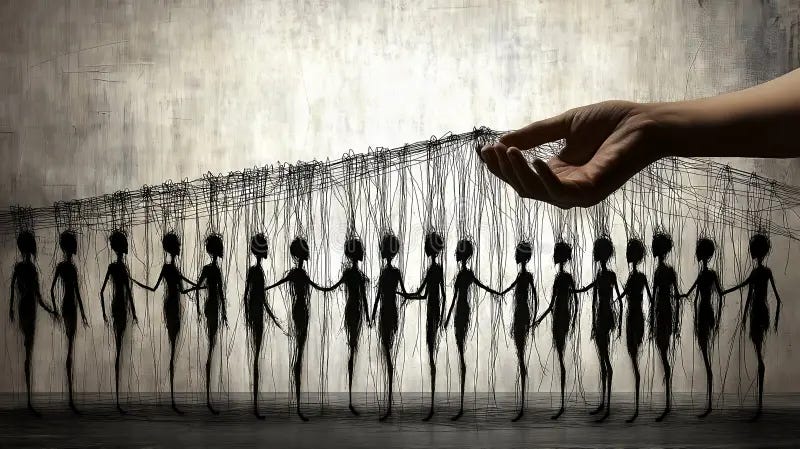
“Politics” today is a muddled mess. It is approaching a Hobbesian “all vs all” world. There are so many layers of abstraction, so many competing interests, all vying for their own benefit. All of them are masked under layers of illusion. In many ways, this is by design. The managerial system disguises within a complex system whose interests are being advocated for. It emphasizes rules and policies, but these rules are often just for show in the world of practical politics. This complexity and the level of abstraction overlaid with ideology of a mass society who are organized into abstract realities like “class” or “the nation state” are all meant to undermine real bonds that might foster a real political consciousness among the people that might lead them to organize for their own existential interests and future. If they do that, many of these other entities and interest that now have a free hand to act as they please and exploit the mass as they see fit, harness the resources of various geographical abstractions for their own benefit, might suddenly find their interests subordinated to those of a specific people. Everything today works to contain “the political” so as not to destabilize “the system.”
The point of all this is to hopefully awaken the realization that if you don’t clearly have a deep bond with a people, a people that you would die for and kill for, people on whose behalf you would act unscrupulously for their continued existence if necessary with great effectiveness, and if the people who are purported to be your leaders are not acting in this manner, you should be asking very pointed questions about who or what they do actually represent. You might be benefitting from a patronage network. But are the people and interests who run that party politics machine actually your “friend” in the Schmittian sense? What interests are driving things? Industrial interests? An ideological commitment? A particular middle eastern nation perhaps? The bankers? Shareholders? Some shady group of oligarchs? Maybe your leadership class, your elites, represent their own interests against the people whom they govern? Maybe you are the “enemy” of your leadership? Think that is wild and far fetched? Elites spouting fine sounding lines about Canada or America while they lock you in your homes and shutter your business all while Amazon adds billions to its bottom line, that wouldn’t happen right? Elites telling you that certain entities are too big to fail and so need trillions in made up money that they then pocket while your wages stagnate and the cost of everything you purchase rises 30%? Just how necessary were the World Wars and the Global War on Terror anyways?
Do you have a people? Really? If you say things like “this will benefit Canadians,” — or Americans — chances are good that you are immersed in the world of “mass politics” and you are committed to an ideology and a series of geographical abstractions. It is time to start thinking about these realities in terms of “the political.” Who are my people? Do I have a people? Am I just an abstraction? Just part of the mass? Am I bought and paid for by someone’s patronage machine? Would I die for the political bosses? Would I kill for them? The pull of the modern world is to massify us. The pull of the modern world is to get us thinking and living within a series of abstractions, a simulacrum, a series of illusions that then allow others to keep us amused and satisfied and using clichés as a substitute for meaningful political analysis while they rule over us and pursue interests that have nothing to do with us and our welfare. It is a hard thing to realize that we are mass man. But realize it we must. Because it is then that we can begin identifying, and working for the existential future of our “friends.”